How face recognition actually works (and how your data is kept safe)
Face ID feels instant. You glance at your phone and it opens. But how does face recognition work behind that split-second interaction? Modern face recognition technology runs a pipeline of geometric transformations, neural networks, and encryption. Nothing about it is magic. It is a short sequence of well-understood steps, and once you see them laid out in order, the whole thing stops feeling mysterious.
The same pipeline that opens your phone is what lets a photo app find every picture you appear in at a 300-guest wedding, without anyone tagging a single face. This is a walk through that pipeline, from the moment a camera notices a face to the moment the right photos land on the right person's phone. It also covers the two questions people actually care about: how often the technology gets things wrong, and what happens to your face data along the way.
How a computer finds a face in the first place
Before software can work out whose face it is looking at, it has to notice that a face is there at all. That is a separate job called face detection, and it runs before everything else. A detector scans the image and draws a box around each face it finds, ignoring the cake, the fairy lights, and the uncle asleep in the corner. Early systems used the Viola-Jones method from the early 2000s; modern ones use neural detectors that cope with crowds, odd angles, and bad light. In a wedding group shot with 40 people, the detector returns 40 boxes, and each box then travels down the rest of the pipeline on its own.
Step 1: aligning the face
Once a face is boxed, we align it. The software finds five landmarks: the two eyes, the tip of the nose, and the two corners of the mouth. Then it warps the crop so those five points always land in the same spots, at the same size, tilt, and spacing. A face shot from below, or leaning 30 degrees, or turned halfway across a room is still the same face, but the raw pixels look wildly different. Alignment cancels most of that out. By rotating, scaling, and nudging every face onto a common template, we hand the next stage a clean, standardized image instead of a random snapshot. This is the reason a selfie you take at arm's length still matches a candid where you are laughing sideways at someone off-camera.
Step 2: turning a face into a vector
This is the part that does the real work, and it is worth slowing down for. Why does it take only seconds to find one face among 80,000 photos, and why does it occasionally mistake your uncle for your other uncle? The answer lives in how a face gets turned into numbers.
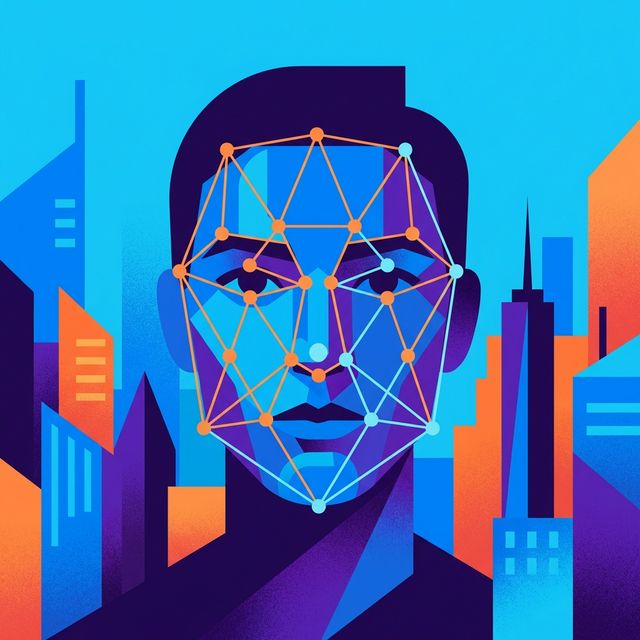
We use deep convolutional networks (like ResNet) to turn your face into a 512-dimensional vector, building on architectures pioneered by Google's FaceNet. This embedding is your "digital face": a mathematical signature that stays consistent even with different lighting or expressions.
A vector is just a list of numbers, and 512 of them describe a single point in a 512-dimensional space. You cannot picture 512 dimensions, so picture three instead: every face becomes a dot floating somewhere in a room. The network is trained on millions of labelled faces with one goal. Two photos of the same person should land as two dots almost on top of each other, and two different people should land far apart. It learns this through loss functions that pull same-identity faces together and push different identities away, so by the end the geometry of the space carries the meaning: distance stands for difference in identity.
Because the vector describes the geometry of your face rather than the pixels of one particular photo, it survives a change of camera, a new haircut, and a decade of birthdays reasonably well. That is what people mean when they call the embedding stable. Store the 512 numbers and the system never needs the original photo again to recognize the person.
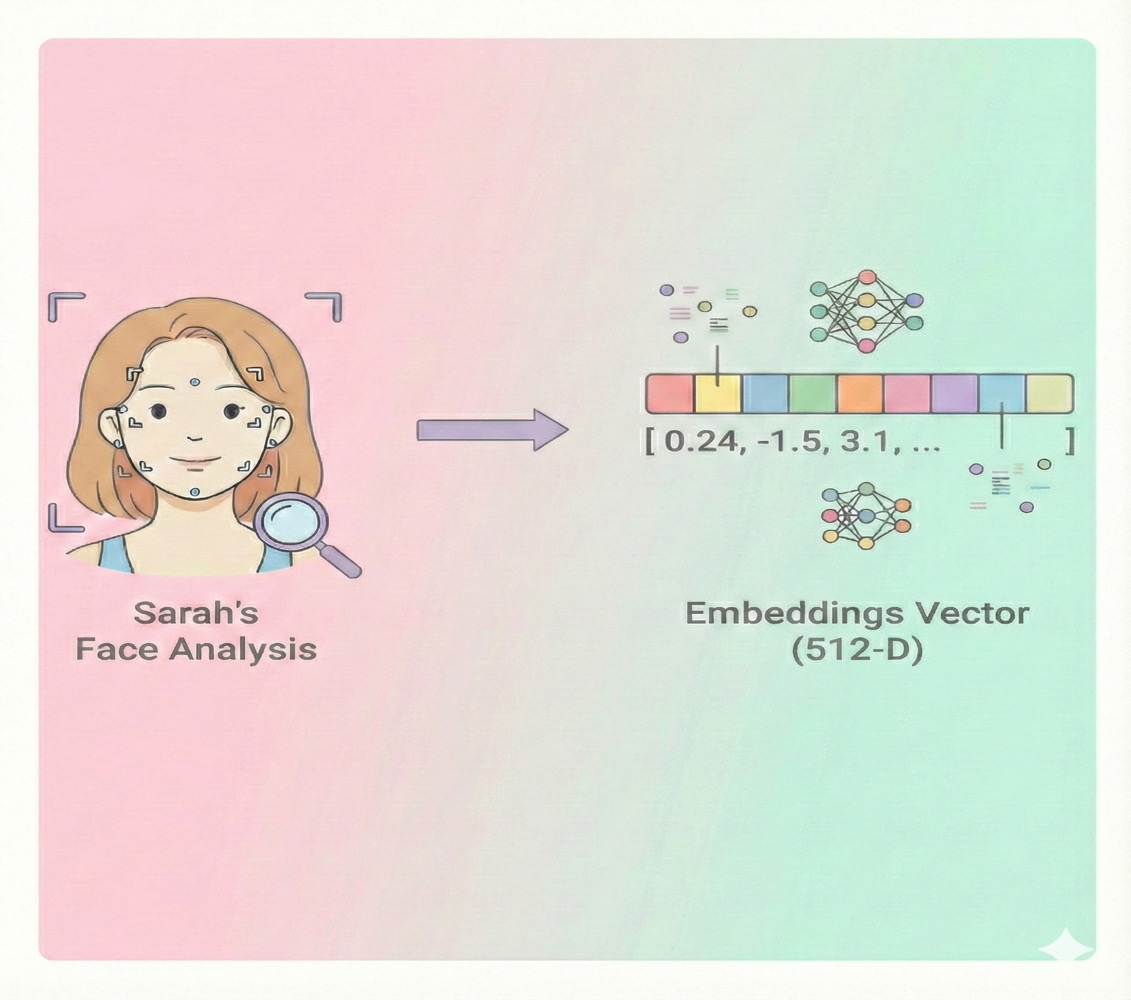
The face vector
A unique numerical representation that allows for instant matching without storing actual photos.
Step 3: matching with cosine similarity
Once every face in the gallery is a vector, and your selfie is a vector too, matching stops being about images and becomes plain geometry. The standard measure is cosine similarity, which looks at the angle between two vectors rather than how far apart they sit. Two vectors pointing in nearly the same direction score close to 1; two unrelated faces score near 0. Pick a threshold, and anything scoring above it counts as a match.
# Minimal Python example for embedding extraction
embeddings = model(aligned_face) # 512-d vector
similarity = cosine_similarity(user_face, gallery_face)
The reason this is fast is that comparing 512 numbers is trivial work for a computer, even repeated tens of thousands of times. Finding you among 80,000 wedding photos means taking the one vector from your selfie and scoring it against every face vector in the gallery, then returning the highest scorers. At larger scales, an approximate nearest-neighbour search narrows the field first, so the system never has to score literally every face one by one. Either way, the app compares the math, not the photographs, which is also why it can sort a whole event without a human ever scrolling through your pictures.
Why face matching is accurate, and where it slips
Matching on the geometry of a face is what makes this reliable. It does not lean on file names, timestamps, camera metadata, or someone manually tagging people, all of which are missing or wrong most of the time. A well-trained system holds up across angle, lighting, expression, and years of aging, which is why you get the photos you are actually in rather than a random handful.
It is not perfect, and it is fairer to say where it struggles. Heavy occlusion throws it off: a mask, a hand across the face, or oversized sunglasses hide the landmarks the model relies on. So do extreme side profiles, strong motion blur, and tiny low-resolution faces in the far background of a shot. A large age gap between the selfie and the photo can drag the score down. And then there are look-alikes. Identical twins and close relatives genuinely land near each other in that 512-dimensional space, because their faces really are geometrically similar, which is exactly why a system can swap one uncle for the other. Where you set the threshold is a trade-off: loosen it and you catch more of your real photos but let in the occasional wrong face; tighten it and the false matches vanish but you might miss a few genuine shots.
What happens to your face data
A face vector is derived from your biometrics, so it deserves the same care as the photo itself. Plenty of systems store these vectors in plain, readable form, which turns a single database breach into a leak of biometric signatures. AccioPix takes a different route. Face vectors are processed inside ephemeral containers and protected with homomorphic encryption, so your biometric signature is never left sitting permanently in a readable, vulnerable state.
Homomorphic encryption is the interesting piece. It lets a server run calculations directly on encrypted numbers without ever decrypting them, so a similarity comparison can happen while the underlying face vector stays scrambled the whole time. Paired with ephemeral containers that spin up for a task and disappear afterwards, it means the matching can run without leaving your biometric data lying around. The selfie you upload to find your photos is used for the match and then discarded rather than filed away. The technology on its own is not the point; how a system handles your data is what decides whether it is safe to use, and that is where the engineering effort goes.
If you're the photographer covering the event
For a photographer, all of this pipeline is invisible, and that is the point. You upload the gallery once and AccioPix handles the sorting and delivery. Guests send a selfie, the face matching runs, and each person receives only the photos they appear in, at full resolution. That removes the slow, thankless part of the job: the "can you send me just my photos?" messages that trickle in for weeks after an event, and the hours lost culling a shared folder by hand.
The business case is straightforward. Faster delivery and self-serve galleries mean happier clients and more referrals, and every guest who pulls their own photos sees your name on the delivery. Pricing is credit-based rather than a monthly subscription, so a 500-photo event runs about ₹100 in credits, which you only spend on events you actually shoot. There is a fuller breakdown of how photographers turn this into repeat work in our guide to growing a photography business, and the workflow specifics live on our photography page.
Face recognition FAQs
How does face recognition work in photos?
A neural network aligns each face, then converts it into a 512-dimensional vector—a numerical signature that stays consistent across lighting and expressions. To find your photos, AccioPix compares the vector from your selfie against the vectors of every face in the gallery and returns the closest matches. It compares the math, not the raw images, which is the core of how face recognition technology works.
How accurate is face recognition for finding my photos?
Modern face recognition technology is highly accurate because it matches the geometry of your face rather than relying on file names, timestamps, or manual tagging. It holds up across different angles, lighting, and expressions, so you reliably receive the photos you actually appear in—though look-alikes such as close relatives can occasionally produce a near match.
Is face recognition private and secure with AccioPix?
Yes. AccioPix takes a privacy-first approach: your face vectors are processed inside ephemeral containers and protected with homomorphic encryption, so biometric signatures are never stored permanently in a readable, vulnerable state. The selfie you upload to find your photos is matched and then discarded rather than kept on file.
The homomorphic encryption math behind matching faces while they stay encrypted.
Why AccioPix's matching approach is fundamentally different from surveillance.
The broader 2026 industry shift toward instant, automated photo delivery.